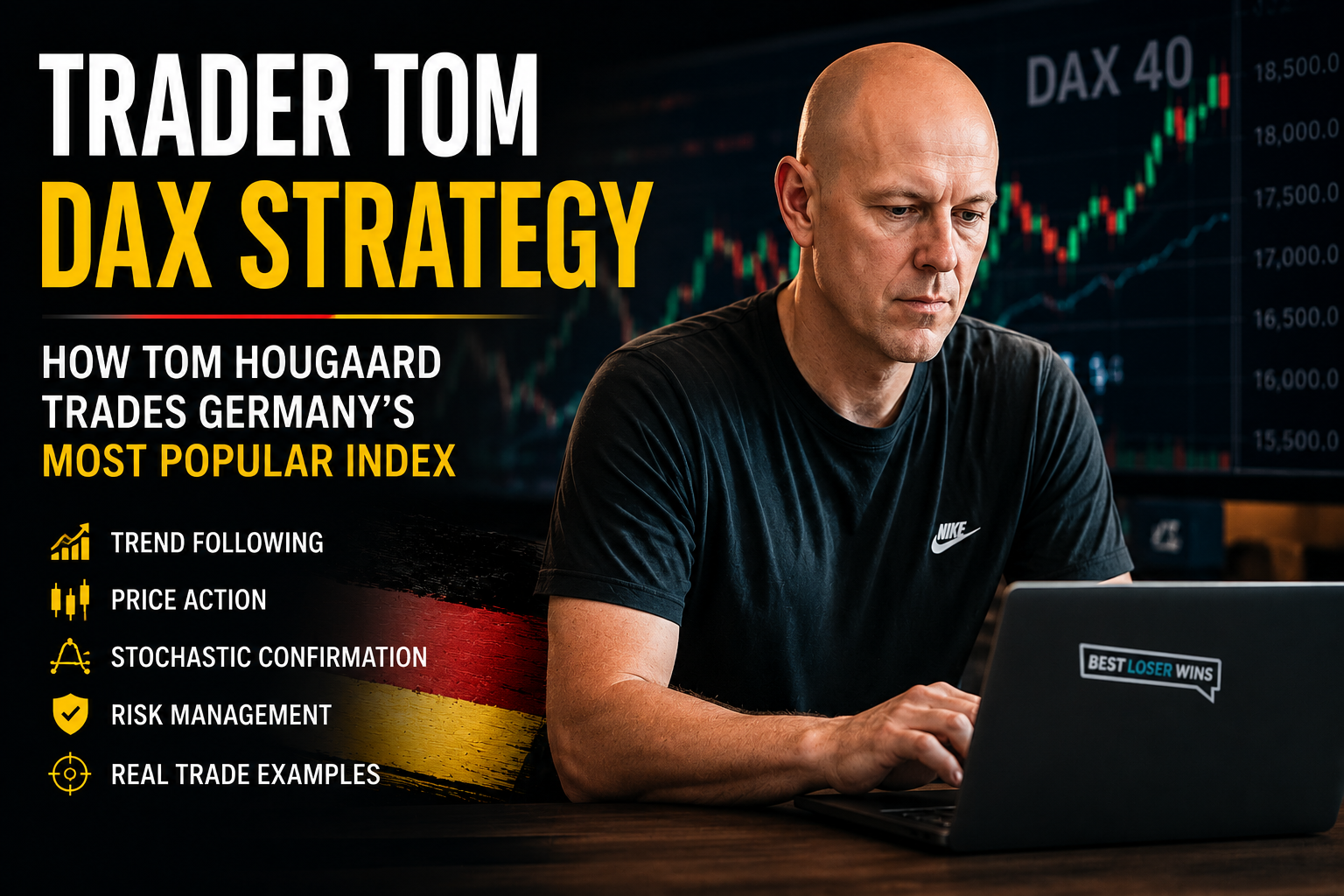
The DAX is one of the most actively traded indices in the world, and for traders who follow Trader Tom’s work, it’s practically a home market. If you’ve been searching for information on the Trader Tom DAX strategy, you’re in the right place.
This article breaks down how Trader Tom approaches Germany’s flagship index – from his trend-following methods and price action principles to the psychology that separates disciplined traders from those who blow up their accounts. While this article focuses specifically on the DAX, it represents only one part of Tom Hougaard’s trading strategy, which also covers psychology, risk management, and trend following across multiple markets.
Note: Tom Hougaard does not publish a fixed mechanical DAX trading system. This article is based on principles he has discussed publicly through Best Loser Wins, his educational content, public trading commentary, and live trading sessions.
Key Takeaways
The Trader Tom DAX strategy isn’t built on complexity. It’s built on consistency. Here’s what matters most:
Trend is everything. Trader Tom DAX trading starts with identifying the dominant direction on the daily chart before a single entry is considered. Trading against the trend isn’t forbidden – it’s just a lower-probability proposition that requires a very specific setup to justify.
Price action is the primary language. Indicators support the read, but the chart itself tells the story. How the DAX behaves at key levels – whether it rejects, consolidates, or breaks through – informs every decision.
The stochastic confirms, it doesn’t lead. A common misreading of Trader Tom’s approach is treating the stochastic oscillator as a signal generator. It isn’t. It’s a confirmation tool used after the directional bias and price action picture are already clear.
Losses are managed before the trade opens. Stop placement, position sizing, and maximum risk per trade are defined before entry – not adjusted emotionally once the trade is live.
Winning trades need room. The risk/reward only works over time if winners are allowed to run past the first temptation to close them.
Psychology is not secondary. As Best Loser Wins makes clear, the mental framework behind each decision is as important as the technical setup itself.
Why the DAX Fits Trader Tom’s Trading Style
Not every market suits every trader. Trader Tom has talked openly about why he gravitates toward fast, high-volume indices – and the DAX consistently ticks every box.
Trader Tom and Trade Nation
Tom Hougaard has publicly mentioned using Trade Nation for his trading.
Why Many Trader Tom Followers Consider Trade Nation
✅ Competitive DAX spreads
✅ Fast execution
✅ No hidden commissions
✅ Regulated broker
👉 Read Our Trade Nation Broker Review
Volatility Creates Opportunity
The DAX 40 is known for sharp intraday moves. German economic data, ECB announcements, and shifts in global risk sentiment can send the index hundreds of points in minutes.
For a momentum-focused trader, that volatility isn’t a problem. It’s the point.
Trader Tom’s approach is built on the premise that markets move in trends, and the DAX – with its regular bursts of directional energy – delivers exactly the kind of price action he looks for. Slow, grinding markets force traders to overanalyse noise. Fast markets, by contrast, reward decisiveness and clear thinking.
Why Trader Tom Prefers Fast-Moving Markets
Trader Tom has spoken extensively about why sluggish, directionless markets frustrate active traders. When price moves with conviction, trade management becomes cleaner. You either have a position working in your favour, or you don’t. The DAX – particularly during the European open and the overlap with the US session – rarely keeps traders in limbo for long.
This connects directly to a core principle from Best Loser Wins: the best trades often feel uncomfortable because they require acting decisively when most traders are still hesitating. Fast markets expose hesitation quickly. That’s uncomfortable – but it’s also clarifying.
The Core Trader Tom DAX Strategy
Trader Tom doesn’t apply a rigid mechanical system to the DAX. What he uses is a consistent framework built around principles that appear repeatedly across his live trading sessions, webinars, and public market commentary.
These principles can be observed repeatedly throughout Tom Hougaard’s public trading sessions, where he demonstrates how trend, momentum, and psychology interact in real market conditions.
These principles form the foundation of Tom Hougaard’s trading strategy and can be applied across indices, forex, and other liquid markets.
Trend Following
At the foundation of the Trader Tom DAX strategy is trend following. He looks for a clear directional bias – higher highs and higher lows for uptrends, lower highs and lower lows for downtrends – and aligns his trades with that existing direction.
This isn’t about predicting where the DAX is heading. It’s about identifying where it is already going and joining that move with controlled risk.
Traders who have watched Tom Hougaard’s live trading sessions will notice that he rarely attempts to predict major turning points. Instead, he focuses on identifying momentum and participating in existing directional moves.
Trader Tom is direct on this point: trying to pick tops and bottoms is a low-probability approach. Trading with a confirmed trend, by contrast, puts the odds on your side. It sounds simple. Executing it consistently, especially when the market pulls back against you before continuing, is far harder.
Price Action
Trader Tom places significant weight on what the chart itself is communicating. Candlestick patterns, how price behaves around key support and resistance levels, and the momentum of individual bars all inform his decisions.
He pays particular attention to how the DAX reacts at significant levels. A sharp rejection from a previous high, a series of narrow-range candles consolidating before a breakout, or a strong momentum candle closing near its high – these are the signals he watches for before committing to a position.
This isn’t chart reading for its own sake. It’s a practical way of assessing whether buyers or sellers are in control at any given moment.
Using the Stochastic Oscillator for Confirmation
Trader Tom is one of the more prominent advocates of the stochastic oscillator among active index traders. He uses it not as a primary entry trigger, but as a confirmation tool – particularly to verify that momentum is aligning with the directional trend he’s already identified.
When the stochastic is rising within an uptrend, or falling within a downtrend, it adds weight to a potential trade. He has also discussed using stochastic crossovers to assess whether a move has exhausted itself or still has room to develop – a useful filter when the DAX is in a strong trend and pullback entries are on the table.
Trader Tom’s Preferred DAX Trading Timeframes
Trader Tom doesn’t work from a single timeframe in isolation. He uses a structured top-down approach to build context before making any entry decision.
Finding the Trend
Higher timeframes – typically the daily chart – provide the directional bias for Trader Tom’s DAX trading. Is the index trending clearly in one direction? Has it been making a consistent series of higher lows? Or is it ranging sideways in a zone where neither bulls nor bears have conviction?
This broader context shapes every trade that follows. Taking a long setup on a 5-minute chart that runs counter to the daily trend is a very different risk proposition to trading in alignment with it. Trader Tom consistently emphasises the importance of that distinction.
Timing Entries and Exits
For actual entries, Trader Tom works on shorter timeframes – often 5-minute or 15-minute charts – where momentum is visible in real time. The goal is to see the shorter-term price action align with the higher-timeframe bias before entering a position.
Exit decisions follow the same logic. He watches for signs that momentum is stalling, that the DAX is approaching a significant level, or that the trade is simply no longer behaving the way the original setup suggested it should.
Risk Management in Trader Tom DAX Trading
Risk management is where the majority of traders come unstuck. Trader Tom is among the more honest voices in the trading world about just how difficult consistent risk management really is.
Position Sizing
Trader Tom is clear that position size must reflect your actual risk tolerance – not your confidence in any particular trade. The DAX moves fast, and sizing too large on a trade that moves against you can turn a manageable loss into a serious account event very quickly.
The principle he returns to repeatedly: if your position size is influencing the quality of your decisions, it’s too large. Trading well requires a degree of emotional detachment from individual trade outcomes, and oversizing makes that detachment almost impossible.
Execution quality matters here too. On a fast-moving index like the DAX, the difference between a tight spread and a wide one can directly affect where your stop sits and how much risk you’re actually taking. It’s worth reading our Trade Nation broker review for context on how execution quality varies between platforms.
Many traders focus entirely on strategy while ignoring execution costs. When trading fast-moving markets like the DAX, spreads and order execution can directly impact profitability.
If you’re evaluating brokers for active index trading, see our Trade Nation Broker Review.
Managing Losing Trades
One of the most distinctive elements of Trader Tom’s approach is his emphasis on how you lose.
In Best Loser Wins, he makes the case that the best traders aren’t necessarily those who win the most often. They’re the ones who lose better than everyone else. They cut losses before they become serious. They don’t add to losing positions hoping for a reversal. They don’t let a bad trade become a bad session.
On the DAX specifically – where moves can be fast and decisive – this discipline isn’t optional. It’s the foundation of long-term survival. Many of these challenges are psychological rather than technical. Fear of losses, revenge trading, and the urge to move stop losses are recurring themes in Tom Hougaard trading psychology.
For a deeper understanding of how Trader Tom’s mindset shapes his trade management under pressure, the section on Tom Hougaard trading psychology covers this in genuine depth.
Letting Winners Run
The counterpart to cutting losses quickly is allowing winning trades room to develop. Trader Tom speaks regularly about the almost universal tendency among traders to close profitable trades too early – locking in a small gain while the market continues moving without them.
The reason this happens is psychological, not analytical. Profit feels good. The fear of watching that profit disappear overrides the rational understanding that the trade is still working.
Trader Tom’s approach is to let the trade prove itself wrong rather than closing it because the profit looks appealing on screen. Practically, this means trailing stops intelligently and resisting the urge to manage a winning trade out of anxiety. On a fast-moving index like the DAX, this is one of the hardest disciplines to maintain – and one of the most important.
Trader Tom DAX Trade Example
The following is a hypothetical example built to illustrate the principles Trader Tom discusses publicly. It is not drawn from any specific trade and should not be treated as a performance record.
Market Setup
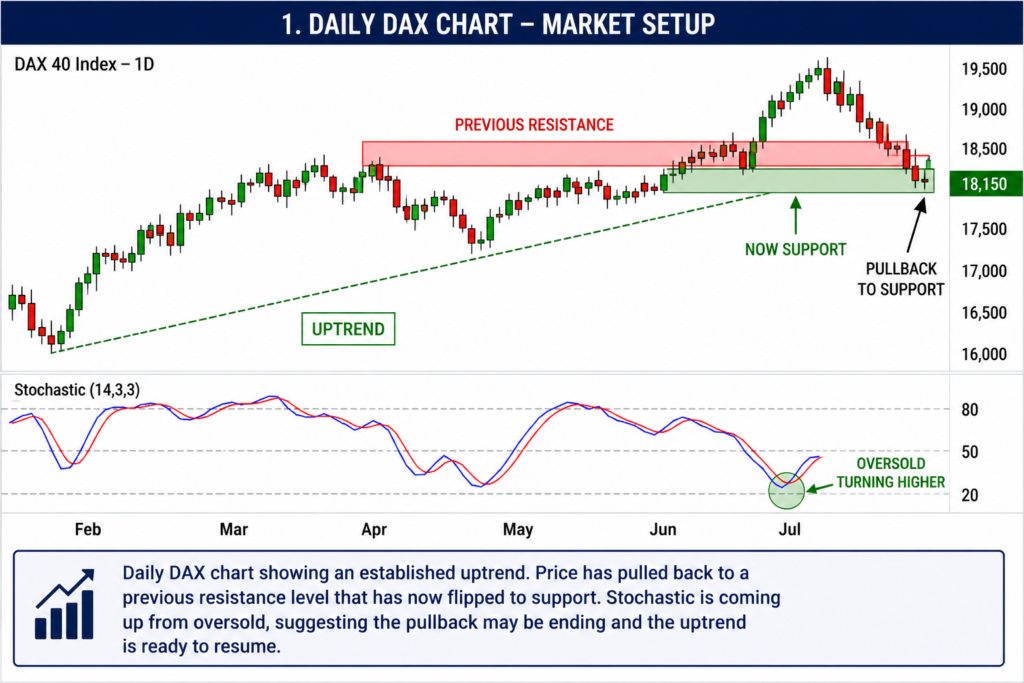
The daily DAX chart is in an established uptrend. Price has pulled back to a level that previously acted as resistance and has now flipped to support. The stochastic oscillator on the daily chart is beginning to turn up from an oversold reading, suggesting the pullback may be losing momentum and the trend is ready to resume.
Entry and Trade Management
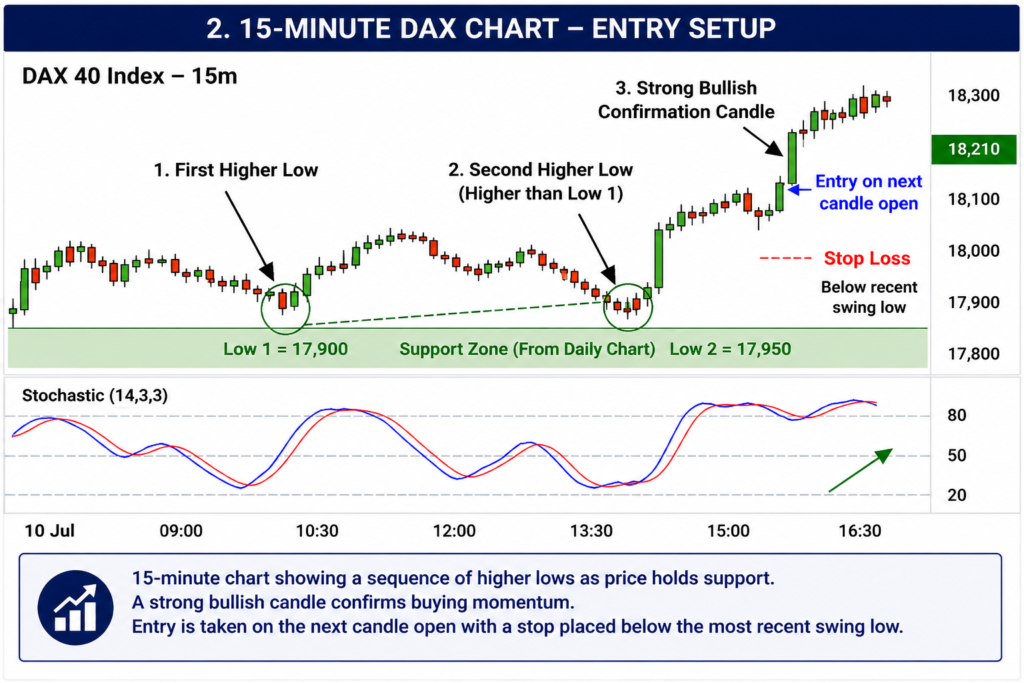
Dropping to the 15-minute chart, a sequence of higher lows begins to form as price stabilises around the support zone. A strong bullish candle closes near its high, confirming the return of buying momentum.
An entry is taken on the following candle’s open. A stop is placed below the most recent swing low, defining the risk clearly before the trade is open.
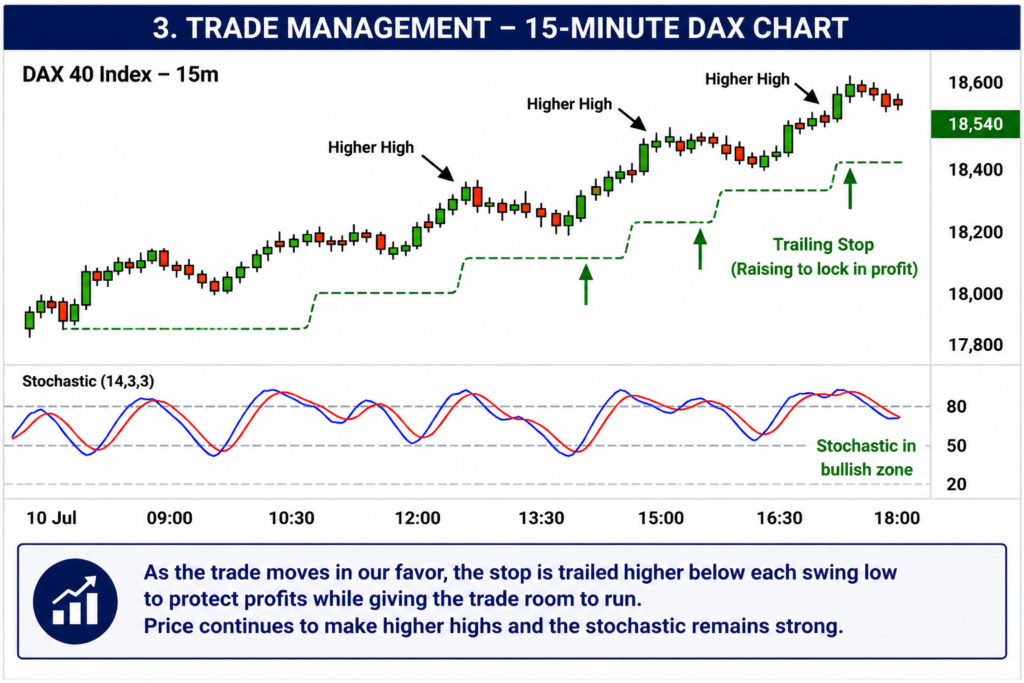
As the trade develops, the stop is trailed upward to protect profit without exiting the position prematurely. The stochastic on the 15-minute chart is rising. The daily trend is supportive. Price is making higher highs. The trade is behaving exactly as the setup suggested it should.
Exit and Lessons Learned
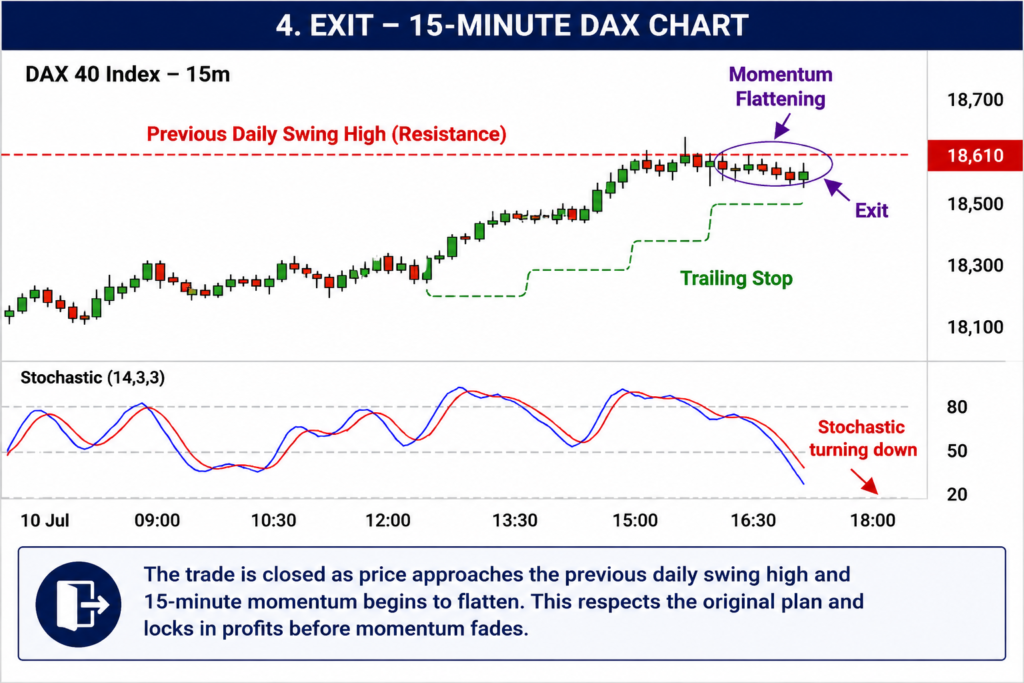
The trade is closed as price approaches the previous swing high on the daily chart and 15-minute momentum begins to flatten. It wasn’t closed the moment it moved into profit, nor was it held beyond the point where the original thesis – continuation of the uptrend from a support level – remained clearly valid.
The lesson is straightforward. The setup worked because trend, price action, and momentum aligned across timeframes. It would have been invalidated cleanly by a close below the entry support zone, at which point the stop would have ended the trade with a controlled, pre-defined loss.
Trader Tom’s approach relies heavily on momentum, trend following, and disciplined execution. Using a broker with competitive spreads and reliable execution can help reduce trading costs over time.
👉 Read Our Trade Nation Broker Review
What Traders Can Learn from Trader Tom’s DAX Approach
The Trader Tom DAX strategy is not a hidden system. It’s a disciplined application of principles that serious traders have used for decades – trend following, price action reading, momentum confirmation, and rigorous risk management.
What makes Trader Tom’s version of these ideas worth studying is how he combines them with an unusually honest treatment of the psychological difficulty involved. He doesn’t present a system that wins most of the time and invite you to follow it mechanically. He talks about losing streaks, the emotional weight of drawdowns, and the sustained mental effort required to keep trading well when results are working against you.
Those conversations – in Best Loser Wins, in his live trading sessions, and in his public market commentary – contain more practical insight than most trading courses manage across hundreds of hours of content.
For traders who have tried strategies that looked clean on paper but fell apart under the pressure of live markets, that honesty is often more useful than any specific entry signal. These same principles appear throughout Tom Hougaard’s trading strategy, whether he is trading indices, forex, or other highly liquid markets. To understand how these concepts fit together as a complete methodology, see our guide to Trader Tom trading strategy.
A Note on Execution and Trading Costs
Even a well-constructed strategy can be undermined by poor execution and excessive trading costs. The DAX moves quickly. When you’re trading intraday with tight stops, the spread you pay on every entry and exit compounds across a full trading session.
Trader Tom has mentioned Trade Nation in connection with his own trading – particularly its competitive spreads on indices and the reliability of its execution. For traders applying a similar approach, platform quality is a practical consideration, not an afterthought.
Why Many Trader Tom Followers Consider Trade Nation
✓ Tight spreads on indices including the DAX
✓ Fast execution with no requotes
✓ No hidden commissions
✓ FCA-regulated broker
👉 Read our Trade Nation broker review before opening an account
Common Mistakes Traders Make When Applying the Trader Tom DAX Strategy
Understanding the principles is one thing. Applying them consistently under live market conditions is another. These are the mistakes that show up most often.
Trading against the trend and rationalising it. The DAX can move sharply in both directions, and it’s tempting to fade a strong move when it looks extended. Trader Tom’s approach is built on trend alignment, not counter-trend fading. Deviating from that – even occasionally – undermines the entire framework.
Using the stochastic as a standalone entry signal. Traders new to Trader Tom DAX trading often latch onto the stochastic oscillator as the core of the strategy. It isn’t. Without the higher-timeframe trend context and supporting price action, stochastic signals are noise.
Oversizing positions on high-conviction setups. A setup that looks perfect is still just a setup. The DAX can reverse sharply on a news catalyst regardless of how clean the technical picture appears. Oversizing because a trade “looks certain” is one of the fastest ways to turn a solid strategy into an account-damaging experience.
Moving stops to breakeven too early. This is a subtle but costly habit. Moving a stop to breakeven the moment a trade ticks into profit feels prudent, but it frequently results in being stopped out of trades that needed slightly more room before continuing in the intended direction.
Closing winners at the first sign of hesitation. The DAX consolidates before continuing. A few sideways candles mid-trend is normal behaviour, not a reversal signal. Closing a winning trade because price paused – rather than because the setup was invalidated – is one of the most common ways traders undermine their own risk/reward.
Skipping the higher timeframe context. Jumping straight to a 5-minute chart without checking the daily trend is trading blind. A setup that looks strong in isolation can be a low-probability counter-trend trade when viewed in proper context.
Treating it as a mechanical system. Trader Tom has been clear that his approach requires judgment, not just rule-following. Traders who attempt to automate or rigidly systematise these principles often find they work in trending conditions and struggle everywhere else – because the discretionary overlay is the part doing the heavy lifting.
Conclusion: Trader Tom DAX Strategy
The Trader Tom DAX strategy comes down to a clear, repeatable set of principles: identify the trend, read the price action, confirm with momentum, size positions sensibly, cut losses without hesitation, and give winning trades the space they need to develop.
None of that is easy. Anyone who suggests otherwise is selling something.
What Trader Tom’s work offers isn’t a shortcut. It’s a framework – grounded in how markets actually behave and in how traders actually think – that can be studied, refined, and applied to a market as demanding as the DAX.
If you want to go further, start with our complete guide to Tom Hougaard’s trading strategy to understand how his DAX approach fits within his broader market methodology. Then work through the material on Tom Hougaard trading psychology – because understanding the mechanics of the strategy is only half of what’s required. The other half is building the mental discipline to execute it consistently, in real markets, when it matters.
Why Many Trader Tom Followers Consider Trade Nation
Tom Hougaard has publicly discussed using Trade Nation due to its trader-focused conditions and competitive pricing.
Why Traders Like Trade Nation
✅ Tight spreads on DAX and major indices
✅ Fast and reliable execution
✅ No hidden commissions
✅ Regulated broker
✅ Suitable for active traders