Trading success is often portrayed as a battle of strategy, indicators, and market analysis. Yet according to Tom Hougaard trading psychology, the biggest challenge traders face is not the market itself – it’s their own mind.
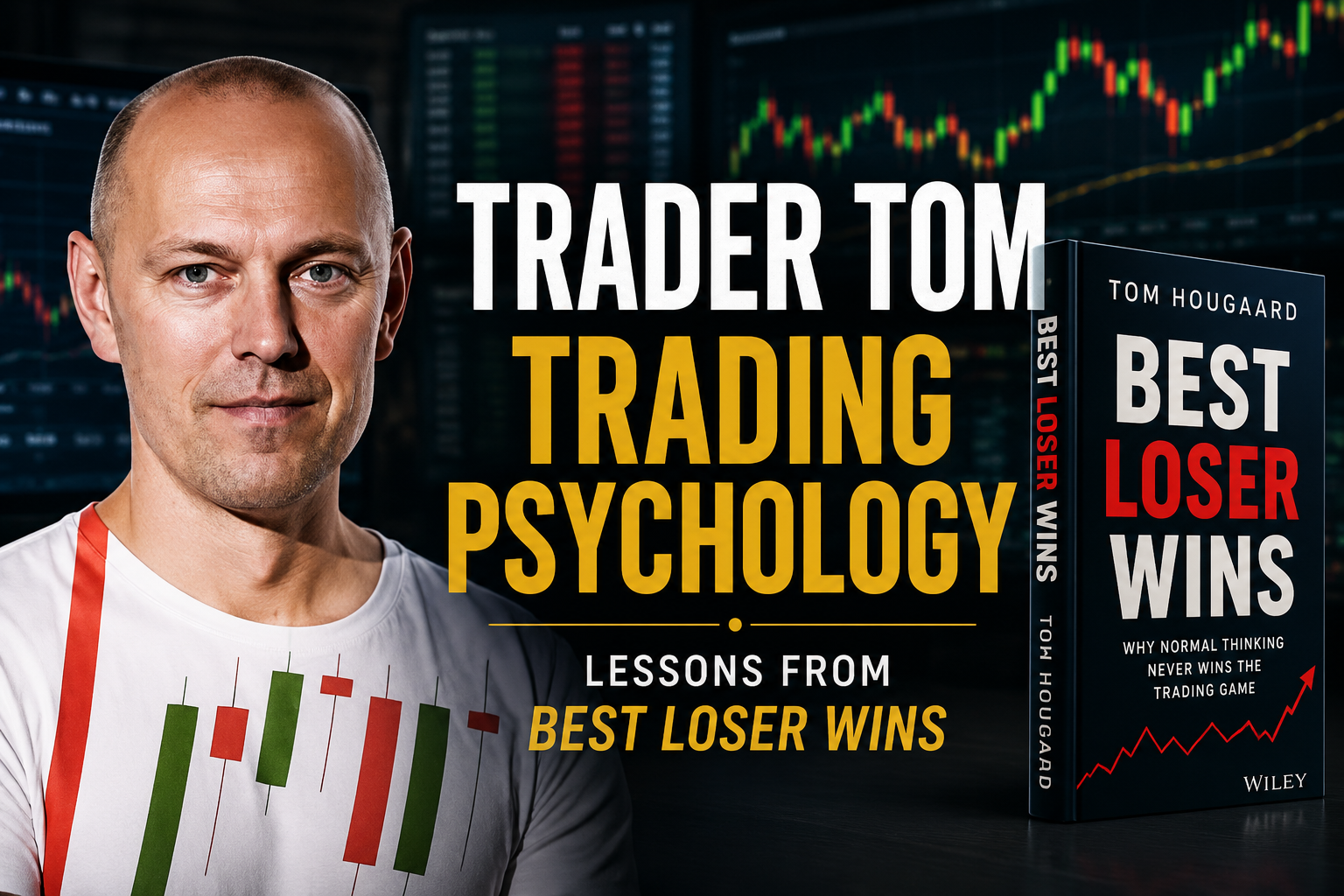
Known to thousands of traders as Trader Tom, Tom Hougaard has built a reputation as one of the most transparent and disciplined traders in the industry. Through his book Best Loser Wins, Trader Tom argues that long-term trading success has less to do with finding the perfect setup and far more to do with mastering fear, uncertainty, and emotional decision-making.
While many educators focus on entry signals and technical analysis, Hougaard’s approach centres on developing the mindset required to execute consistently under pressure. To understand how psychology fits into his overall methodology, see our guide to Tom Hougaard’s full strategy framework or read our Trade Nation Broker Review.
In this guide, we’ll break down the key lessons behind Trader Tom’s trading psychology, explain how they apply to everyday traders, and explore why many followers consider Best Loser Wins one of the most important trading psychology books ever written.
Key Takeaways
- Psychology matters more than most traders realise
- Loss aversion causes traders to hold losers too long
- The disposition effect encourages taking profits too early
- Trader Tom teaches traders to embrace discomfort
- Small losses are the price paid for big winners
Why Trading Psychology Matters More Than Most Traders Realise
Most traders enter the market believing they need:
- A better strategy
- More indicators
- Faster execution
- Better market predictions
While those factors can help, they are rarely the main reason traders fail.
According to Trader Tom (Tom Hougaard), many traders already possess strategies that can generate profits over a large sample of trades. The problem is not usually the strategy itself – it is their ability to execute that strategy consistently under pressure.
Many traders:
- Exit winners too early
- Hold losers too long
- Increase risk after losses
- Trade emotionally
- Break their own rules
In other words, psychology destroys the edge long before the strategy does.
One of the central ideas behind Tom Hougaard trading psychology is that successful trading is less about finding the perfect setup and more about managing your own behaviour. Markets constantly test a trader’s emotions, patience, discipline, and ability to tolerate uncertainty.
A trader may know exactly where their stop-loss should be yet move it further away to avoid taking a loss. Another trader may have a profitable position but close it prematurely because they fear giving back unrealised gains. These decisions are rarely caused by a lack of market knowledge. Instead, they are driven by fear, greed, hope, and the natural human desire to avoid discomfort.
Trader Tom frequently argues that profitable trading requires learning to act differently from normal human instincts. The behaviours that help us in everyday life—avoiding pain, seeking certainty, and wanting immediate rewards – often work against us in financial markets.
This is why two traders can use the exact same strategy and achieve completely different results. The difference is not the system itself but the psychological ability to execute it consistently through winning streaks, losing streaks, drawdowns, and periods of uncertainty.
For Tom Hougaard, trading psychology is not a supplement to a trading strategy. It is the foundation that determines whether a trader can successfully apply that strategy over the long term.
The Behavioural Finance Behind Trader Tom’s Philosophy
One reason Trader Tom’s teachings resonate with so many traders is that they directly challenge the psychological biases that behavioural finance researchers have been documenting for decades.
Long before Tom Hougaard wrote Best Loser Wins, psychologists such as Daniel Kahneman, Amos Tversky, and Richard Thaler demonstrated that humans are not naturally wired to make rational decisions under uncertainty. Financial markets expose these weaknesses every day.
Trader Tom’s philosophy can be viewed as a practical framework for overcoming some of the most common behavioural biases in trading.
| Behavioural Bias | How Most Traders React | What Trader Tom Teaches |
|---|---|---|
| Loss Aversion | Avoid taking losses and hope the market recovers. | Accept small losses quickly and move on. |
| Disposition Effect | Take profits early and hold losing trades longer. | Let winning trades run and cut losing trades quickly. |
| Regret Aversion | Trade to avoid being wrong or missing out on opportunities. | Trade to make money, not to protect your ego. |
Loss Aversion: Why Traders Hate Taking Losses
Loss aversion, identified by Kahneman and Tversky, describes our tendency to experience losses more intensely than equivalent gains. In simple terms, losing $1,000 hurts far more than making $1,000 feels good.
This creates a major problem for traders.
When a position moves against them, many traders refuse to exit because taking the loss feels emotionally painful. Instead, they widen stops, average down, or simply hope the market turns around.
Trader Tom’s solution is deliberately counterintuitive: learn to lose.
Rather than avoiding losses, Tom Hougaard encourages traders to embrace small, controlled losses as a normal cost of doing business. A trader who can consistently take small losses preserves both capital and psychological stability.
As Trader Tom often says:
“The best traders are often the best losers.”
The Disposition Effect: Why Traders Do the Opposite of What Works
The disposition effect is the tendency to sell winning positions too early while holding losing positions for too long.
Most traders feel an urge to lock in profits the moment they appear. At the same time, they hesitate to close losing trades because doing so forces them to admit they were wrong.
Unfortunately, this creates the exact opposite of a profitable trading profile.
Small winners and large losers eventually destroy even a decent strategy.
Trader Tom’s philosophy attacks this bias head-on. His approach is simple but psychologically difficult: cut losers quickly and allow winners the opportunity to become much larger than expected.
The goal is not to maximise your win rate. The goal is to maximise your expectancy.
Regret Aversion: Trading to Protect Your Ego
Regret aversion occurs when traders make decisions designed to avoid future emotional pain.
This is often the hidden force behind FOMO and stubborn losing trades.
One trader chases a breakout to avoid regretting a missed opportunity. Another keeps a losing position open because they do not want to admit their analysis was wrong.
In both cases, the decision is driven by emotion rather than probability.
Tom Hougaard repeatedly emphasises that trading is not about being right.
It is about making money.
Professional traders understand that being wrong is part of the business. What matters is how much they lose when they are wrong and how much they make when they are right.
What Trader Tom Teaches About Acting Differently From the Crowd
At the heart of Tom Hougaard’s trading philosophy is a simple but uncomfortable truth: profitable trading requires acting against normal human instincts.
Most traders are constantly searching for comfort. They want certainty before entering a trade, reassurance while holding it, and immediate gratification when it moves in their favour. The problem is that markets rarely reward comfort.
According to Trader Tom, the behaviours that feel best in the moment are often the behaviours that damage long-term performance.
| The Crowd | Trader Tom |
|---|---|
| Takes quick profits to lock in gains. | Lets winners run and allows exceptional trades to grow. |
| Moves stops to breakeven at the first opportunity. | Gives trades room to breathe and accepts normal market volatility. |
| Avoids losses and hopes losing trades recover. | Embraces small, planned losses as a normal business expense. |
Most traders know what they should do. The challenge is doing it when real money is on the line.
Taking a small loss feels uncomfortable. Holding a winning trade feels uncomfortable.
Watching a position fluctuate without interfering feels uncomfortable. Yet these are precisely the situations where discipline matters most.
As Tom Hougaard often suggests, profitable trading is not about finding comfort – it is about becoming comfortable with discomfort.
“The crowd seeks comfort. The profitable trader seeks discomfort.”
This mindset is what separates traders who consistently follow their edge from those who constantly sabotage it.
Contrarian Rule: When a trading decision feels emotionally comfortable, stop and ask whether you’re protecting your profits – or protecting your ego.
Key Lessons From Best Loser Wins
Tom Hougaard’s Best Loser Wins is not another trading strategy book filled with indicators, chart patterns, or market predictions. Instead, it focuses on the psychological habits that separate consistently profitable traders from everyone else.
While the book covers a wide range of concepts, a handful of lessons stand out because they directly challenge the way most traders naturally think and behave.
Many traders read Best Loser Wins and immediately focus on psychology, but execution still matters. Applying Trader Tom’s principles becomes easier when you’re trading in a low-friction environment with predictable costs and risk management tools. If you’re considering a broker aligned with this approach, Trade Nation offers competitive spreads and straightforward pricing for active traders.
Losses Are Tuition
Small, frequent losses are not a sign that something is wrong. They are the cost of doing business and the price paid for finding the occasional large winner.
This contradicts normal trading instincts because most traders view losses as failures rather than necessary expenses.
The Best Losers Win
One of Tom Hougaard’s most famous ideas is that the traders who handle losses best often perform the best over the long run.
Most traders spend their careers trying to avoid losses. Profitable traders focus on controlling them.
This feels unnatural because the human brain is wired to avoid pain and seek certainty.
Trade Size for Indifference
Trader Tom frequently argues that position sizes should be small enough that no single trade has a significant emotional impact.
If a trade keeps you awake at night, causes stress, or tempts you to interfere with your plan, the position is probably too large.
This goes against the instinct to increase size quickly in pursuit of faster profits.
Trader Tom frequently argues that traders should size positions so that no single trade has a significant emotional impact. Trading with predictable costs and transparent pricing can make this easier to achieve.
Trade Nation is a broker frequently associated with Trader Tom due to its trader-friendly conditions, including:
✅ Competitive spreads on major indices and forex pairs
✅ No hidden commissions
✅ Fast execution
✅ Strong regulatory oversight
If you’re looking to apply Trader Tom’s principles in a low-friction trading environment, check out Trade Nation or read our full Trade Nation Broker Review before getting started.
Stop Hunting Yourself
Many traders place obvious stop-loss orders exactly where everyone else does and then become frustrated when they are stopped out before the market reverses.
Tom Hougaard encourages traders to use wider, more logical stops that reflect market structure rather than emotional comfort.
This feels uncomfortable because wider stops often mean accepting larger fluctuations before a trade works.
Discipline Over Prediction
Perhaps the most important lesson in the book is that long-term success has less to do with being right and more to do with acting correctly.
Most traders obsess over forecasting the next market move. Trader Tom focuses on execution, risk management, and consistency.
This challenges the natural desire to prove that our analysis is correct.
If you only remember one thing from Best Loser Wins, remember this: the goal is not to avoid losses—the goal is to manage them so well that your winners can do the heavy lifting.
Conclusion: The One Trait That Separates Consistent Winners
If there is one lesson to take away from Tom Hougaard’s trading psychology, it is that profitable trading has far less to do with strategy than most traders believe.
Most traders already know enough. They understand risk management, position sizing, and trading rules. The problem is not knowledge. The problem is execution.
This is where Trader Tom’s philosophy becomes so powerful. He recognises that the biggest obstacles to profitability are psychological. Loss aversion causes traders to avoid taking necessary losses. The disposition effect encourages them to take profits too early while holding losing positions for too long. Left unchecked, these biases quietly destroy even the best trading strategies.
The uncomfortable truth is that reading about trading psychology changes nothing.
Understanding these concepts is not the same as applying them when real money is on the line.
So, before you search for another indicator, strategy, or market prediction, ask yourself a different question: am I consistently executing the strategy I already have?
Today, take ten minutes to review your last five losing trades without judgement. If you’re rebuilding discipline, consider reducing position size and simplifying your trading environment for a few weeks. Many traders find it easier to focus on execution when trading with a straightforward broker setup. You can start with Trade Nation here.
Focus only on whether you followed your process – not whether the trade made or lost money.
Because in the long run, successful traders are not rewarded for being right. They are rewarded for being disciplined.
Final contrarian rule: The behaviour that feels most uncomfortable is often the behaviour that leads to the best trading results.